
Fair Workweek Laws: A Guide to Predictive Scheduling
BLOG Last updated October 23, 2026
For a lot of hourly workers, the roster used to arrive a few days before the week started, and it could change the night before. Fair Workweek laws, also called predictive scheduling or secure scheduling laws, were written to stop that. They make employers in certain industries post schedules well ahead of time, pay staff when those schedules change at short notice, and give people enough rest between shifts.
These laws are spreading across the United States, and the penalties add up quickly because they are counted per employee, per shift. This guide explains what the laws ask of you, where they apply, and how to run a schedule that keeps you on the right side of them.
What Fair Workweek Laws Require
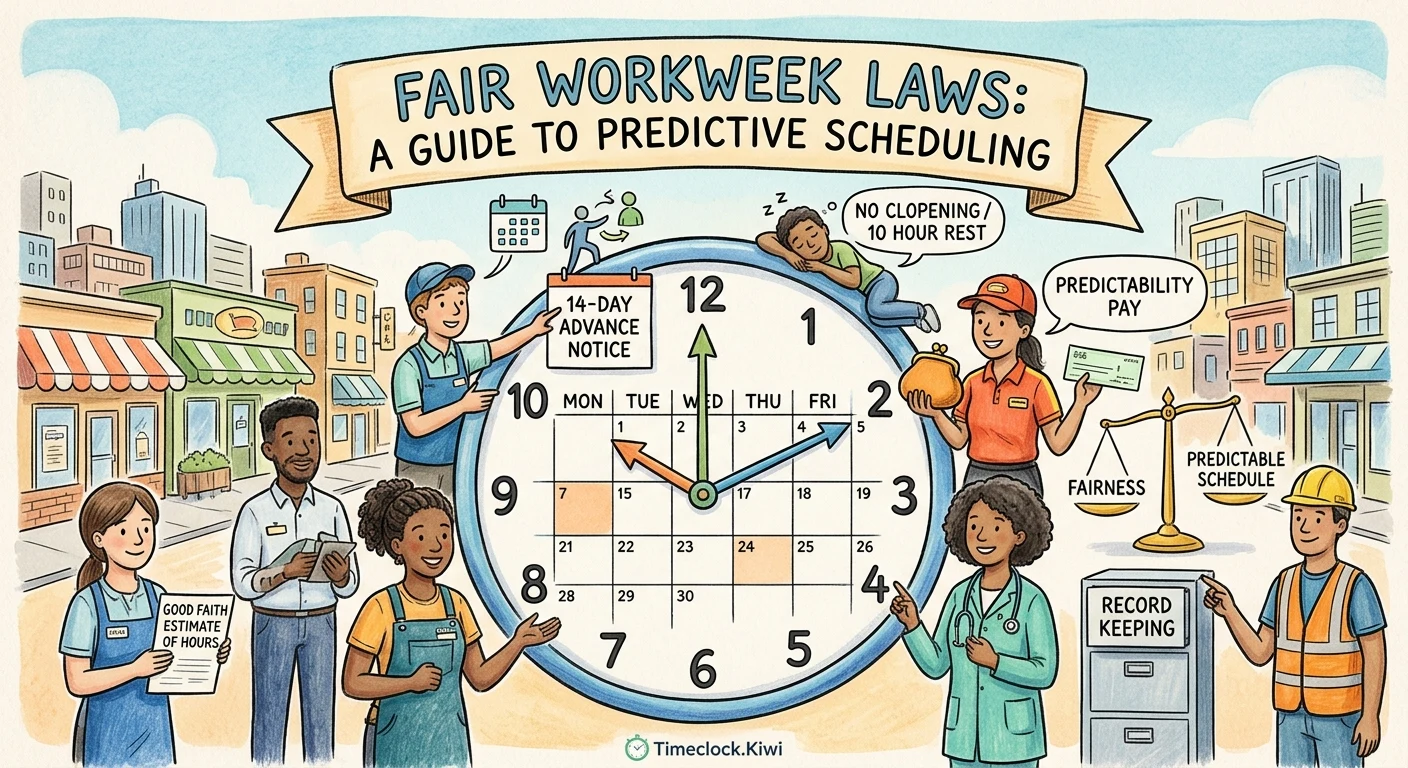
Every jurisdiction writes its own rules, but nearly all of them are built from the same six pieces.
1. Advance notice of schedules
Employers must give staff their written schedule a set number of days before the work period starts. Fourteen days is the standard almost everywhere. The main outlier is New York City's retail rule, which only asks for 72 hours.
2. Predictability pay for late changes
Once the schedule is posted, changing it inside the notice period usually costs extra. Adding hours, cutting hours, moving a shift or cancelling it can each trigger a payment, often an extra hour of pay at the employee's regular rate, and more when hours are cut at very short notice. In many places the employee can also simply refuse the change.
3. Rest between shifts
The "clopening", closing late and then opening early the next morning, is the target here. Most laws give staff the right to refuse a shift that starts less than 10 hours after their last one ended. A few set it differently: 11 hours in Berkeley, Evanston and New York City fast food, and 9 hours in Philadelphia. If they agree to work it anyway, they are usually owed a premium, often time and a half for the hours inside the rest window, and some cities also need their consent in writing.
4. A good faith estimate of hours
New hires must be told, in writing, roughly how many hours, which days and which shifts they can expect. Chicago, for example, asks for an estimate covering the first 90 days, and its rules updated in June 2026 spell out that it must include expected weekly hours, workdays, shift times, work locations, whether on-call shifts are likely, and the date the estimate was given.
5. Offering hours to existing staff first
Several laws require employers to offer extra hours to their current part-time staff before hiring new people or bringing in temps. The idea is that the people already on your team get the first chance at more work.
6. Keeping records
To prove you have done all of the above, you need records: every posted schedule, every change and when it was made, any written consent from staff, and the hours people actually worked. Three years is the common retention period.
Where Fair Workweek Laws Apply
Oregon is the only state with its own law. The rest are city or county ordinances, and each one covers specific industries and employer sizes, so a business can be covered in one location and not in the next. These are the main ones:
| Jurisdiction | In force | Who it covers (in short) | Notice |
|---|---|---|---|
| San Francisco, CA | 2015 | Chain retail with 40+ locations worldwide and 20+ staff in the city | 2 weeks |
| Emeryville, CA | 2017 | Retail and fast food with 56+ staff worldwide (fast food also needs 20+ in the city) | 2 weeks |
| New York City, NY | 2017 | Fast food chains, and retail with 20+ staff in the city | 14 days (fast food), 72 hours (retail) |
| Seattle, WA | 2017 | Retail and food service with 500+ staff worldwide (full service restaurants also need 40+ locations) | 14 days |
| Oregon (statewide) | 2018 | Retail, hospitality and food service with 500+ staff worldwide | 14 days |
| Philadelphia, PA | 2020 | Retail, hospitality and food service with 250+ staff and 30+ locations worldwide | 14 days |
| Chicago, IL | 2020 | Seven industries including retail, restaurants, hotels, healthcare and warehouses, at employers with 100+ staff worldwide (250 for nonprofits) | 14 days |
| Los Angeles (city), CA | 2023 | Retail with 300+ staff worldwide | 14 days |
| Berkeley, CA | 2024 | Employers with 10+ staff in the city in industries including retail, hotels, healthcare, manufacturing and warehouses | 14 days |
| Evanston, IL | 2024 | Hospitality, retail, warehouse, manufacturing and building services employers with 100+ staff worldwide (restaurants: 200+ staff and 30+ locations) | 14 days |
| Los Angeles County, CA | July 2025 | Retail with 300+ staff worldwide, in unincorporated areas of the county | 14 days |
Thresholds and amounts change, and each ordinance has its own definitions and exceptions. Always check the official source for every location you operate in. Each place in the table links to its official Fair Workweek page.
A closer look at New York City

New York City splits its rules by industry. Fast food employers must post schedules 14 days ahead and pay a schedule change premium of roughly $10 to $75 per change, depending on how late it is and what changed. They also can't schedule a clopening with less than 11 hours between shifts unless the employee agrees in writing, and then owe them an extra $100. Retail employers only need to give 72 hours' notice, but they can't use on-call shifts at all. Both must keep schedules, written consents and hours actually worked for three years.
A closer look at Chicago

Chicago's ordinance is one of the broadest, covering seven industries rather than just retail and food. Schedules must be posted 14 days ahead. Changes after that earn one hour of predictability pay per changed shift, and staff can decline hours they weren't given in time. Employees can refuse a shift that starts less than 10 hours after their previous one, and are owed time and a half if they work it. New hires get a written good faith estimate for their first 90 days.
Changes That Usually Don't Count
Predictability pay is meant to stop employers pushing changes onto staff. Most laws therefore exclude changes the employee asked for or chose themselves, such as:
- Time change requests the employee made, like asking to start later
- Shift swaps between coworkers
- Open shifts an employee volunteered to pick up
- Events outside your control, such as power outages, natural disasters or threats to public safety
Many laws expect a written record of the employee's request or consent, which brings us back to record keeping.
Why Spreadsheets and Group Chats Fall Short
The hard part of Fair Workweek compliance isn't knowing the rules. It's proving, months later, exactly when a schedule went out, who changed which shift, how much notice the employee was given, and whether they asked for it. A roster in a spreadsheet and a change sent in a group chat can't answer those questions in an audit or a claim, and when the records are missing, the employer is usually the one who loses the argument.
That is why most covered employers move to scheduling software that keeps the history for them.
How Timeclock.Kiwi Helps
Our shift scheduling was built with these rules in mind. Each schedule has a Fair Workweek setting, and here is how it lines up with what the laws ask for:
- Advance notice: set your notice period (14 days by default). If you publish a week inside it, you're warned before staff are notified. Publishing sends every employee their shifts by push notification and email straight away, or at a time you choose.
- Predictability pay: every change to a published shift is logged with how many hours' notice it gave. Manager changes made inside the notice period are flagged as possibly owing predictability pay, both in the change log and when you publish the changes.
- Employee requested changes: time change requests, shift swaps and claimed open shifts are logged as the employee's choice, so they aren't confused with changes you made.
- Rest between shifts: set a minimum rest period (for example 10 or 11 hours) and any clopening is flagged on the schedule before you publish it.
- Consent: staff can accept or decline each published shift in the mobile app, so you have their answer on record.
- Access to hours: post open shifts that your existing staff can claim in the app, then approve who gets them.
- Record keeping: the change log is kept permanently and exports to CSV for payroll or an audit, alongside the actual clock in and clock out times captured by your time clock.
Because predictability pay amounts differ from city to city, we flag the changes that may owe it rather than adding a fixed amount for you. Your payroll team can then apply the right rate for each location.
A Compliance Checklist
- Map your locations, list every city and county you operate in and check whether an ordinance covers your industry and size there
- Set your notice period to the longest one that applies, and plan schedules at least that far ahead
- Set a minimum rest period between shifts that matches the strictest local rule
- Write good faith estimates for new hires, and keep a dated copy
- Offer extra hours to existing staff before hiring, and keep a record that you did
- Record why every late change happened, especially whether the employee asked for it
- Pay predictability pay on the next payroll for any change that owes it
- Keep everything for at least three years, including schedules, changes, consents and hours worked
Outside the United States
Fair Workweek is an American term, but the same ideas exist elsewhere. In New Zealand, the Employment Relations Act requires employment agreements to set a reasonable notice period for cancelling a shift, and compensation when that notice isn't given. In Australia, many modern awards set minimum notice for roster changes. The tools that help with Fair Workweek, clear notice periods, a full change history and rest between shifts, are good practice wherever you schedule shift workers.
Loïc Joachim
Loïc Joachim is a New Zealand-based IT professional, entrepreneur, and political figure, currently serving as the Managing Director for Timeclock.Kiwi and the IT Manager for the O'Brien Group. He is also involved in politics as the Deputy Chair of the Dunedin Labour Party and is a prolific writer who shares his knowledge and opinions on technology, business, and political affairs.